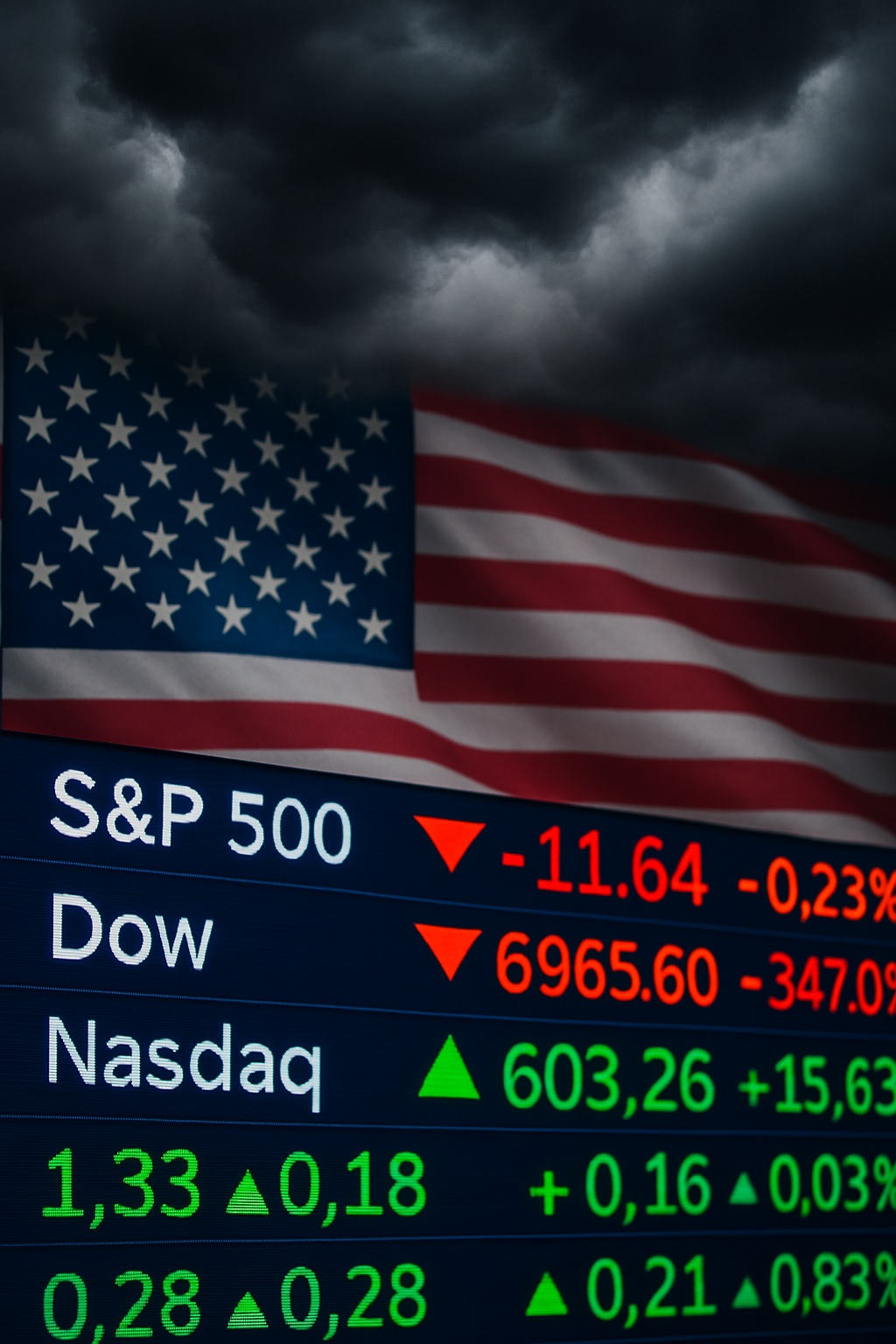
The Dow Jones Industrial Average suffered its worst beating in three weeks today, July 7, 2025, crashing 422 points as President Trump dropped a tariff bombshell that sent shockwaves through global stock markets.
This wasn’t just another minor market dip. The 0.94% decline in the Dow Jones stock markets marked a decisive moment that caught many investors off guard. The S&P 500 fell 0.79%, while the Nasdaq dropped 0.92%, painting a picture of widespread market distress.
But here’s what really matters: this crash wasn’t random. It was the direct result of calculated policy moves that are reshaping how we think about global trade and market stability.
The Numbers That Tell the Real Story
When the Dow Jones stock markets opened today, few expected the carnage that followed. The 422-point drop wasn’t just a number on a screen. It represented billions in lost market value and thousands of affected portfolios.
The automotive sector took the hardest hit. Toyota shares plummeted 4%, while Nissan got hammered with a 7.16% decline. Honda wasn’t spared either, dropping 3.86% as investors fled anything connected to the affected countries.
These weren’t small companies having a bad day. These are major players in the global economy, and their stock performance directly impacts the Dow Jones stock markets that millions of Americans depend on for their retirement savings.
Trump’s Tariff Announcement: The Catalyst That Shook Markets
Today, President Trump announced new tariffs ranging from 25% to 40% on imports from 14 countries. The announcement came through letters posted on Truth Social, targeting nations including Japan, South Korea, Malaysia, Kazakhstan, and South Africa.
The scale is staggering. These tariffs affect $465 billion in imports, with Japan and South Korea alone accounting for $280 billion of that total. That’s 60% of the impact hitting just two countries.
But Trump didn’t stop there. He also slapped an additional 10% tariff on BRICS-aligned nations like Brazil, Russia, China, and India, citing what he called “anti-American” policies.
The original deadline was July 9, 2025, but Trump extended it to August 1, 2025. This extension might seem like good news, but it actually created more uncertainty in the Dow Jones stock markets.
Why the Dow Jones Is Particularly Vulnerable
The Dow Jones stock markets aren’t just numbers floating in cyberspace. They represent real companies with real supply chains that depend on global trade. When those supply chains get disrupted, stock prices follow.
Take semiconductors, for example. Malaysia supplies $18 billion worth of semiconductors to the U.S. market. A 24% tariff on these imports means higher costs for American companies that rely on these components.
South Africa provides 50% of America’s platinum imports. A 30% tariff on platinum doesn’t just affect mining companies. It impacts every industry that uses platinum, from automotive to electronics.
The interconnected nature of modern business means that tariffs in one sector ripple through the entire Dow Jones stock markets. Companies that seem unrelated to international trade suddenly find their costs rising and their profit margins shrinking.
Historical Context: This Isn’t Trump’s First Tariff Rodeo
Today’s announcement wasn’t Trump’s first attempt to use tariffs as a negotiating tool. Earlier tariff announcements in February and April 2025 also triggered significant market reactions.
In February, Bitcoin dropped below $100,000 following tariff announcements. April saw crypto prices fall into the $80,000 region before recovering. The pattern is clear: tariff announcements create volatility across all markets, not just traditional stocks.
What makes this latest round different is the scale and scope. Fourteen countries receiving tariff threats simultaneously represents an escalation that the Dow Jones stock markets hadn’t priced in.
The Cryptocurrency Connection: Bitcoin’s Wild Ride
While most people focus on how tariffs affect traditional Dow Jones stock markets, the cryptocurrency market tells an equally important story. Bitcoin dropped near $108,000 immediately following today’s tariff announcement.
But here’s where it gets interesting: Bitcoin later recovered above $109,000 after the weekend. This recovery pattern suggests that crypto markets might be more resilient to tariff shocks than traditional stocks.
Some analysts believe tariffs could weaken the dollar’s dominance, potentially creating space for Bitcoin and other cryptocurrencies in the long term. The crypto community remains divided on whether tariffs help or hurt digital assets.
What Wall Street Experts Are Saying
The Federal Reserve is unlikely to cut rates this year due to tariff-related inflation concerns. This stance puts additional pressure on the Dow Jones stock markets, as higher rates make borrowing more expensive for companies.
Treasury Secretary Scott Bessent confirmed that no reciprocal rates would be implemented until August 1, with expectations of major announcements within 48 hours of the original deadline.
Wall Street analysts from Capital Economics suggest that while tariff uncertainty may not halt the U.S. economy, it could dampen equity enthusiasm. This dampened enthusiasm directly translates to lower stock prices across the Dow Jones stock markets.
Defensive Strategies for Investors
Smart investors don’t panic when the Dow Jones stock markets face uncertainty. They adapt. The key is understanding which sectors face the greatest risk and which might benefit from the changing landscape.
Companies with heavy international exposure, particularly to the 14 targeted countries, face the most immediate risk. This includes automotive manufacturers, semiconductor companies, and importers of raw materials like platinum.
Defensive sectors like utilities, consumer staples, and healthcare might offer more stability during this period of uncertainty. These sectors tend to be less dependent on international trade and more focused on domestic consumption.
Geographic diversification becomes crucial when tariffs target specific countries. Companies with operations spread across multiple regions can better weather trade disputes than those concentrated in affected areas.
The August 1 Deadline: What Happens Next
The August 1, 2025, deadline looms large over the Dow Jones stock markets. The tariffs are being imposed under the International Emergency Economic Powers Act, which is currently under court review.
This legal uncertainty adds another layer of complexity to an already volatile situation. If the courts rule against the tariffs, we could see a significant rally in the Dow Jones stock markets. If they uphold them, further declines seem likely.
The best-case scenario involves successful negotiations leading to tariff rollbacks. The worst case sees trade war escalation and continued market decline. Most likely, we’ll see continued volatility until there’s some resolution.
Industry-Specific Impact Analysis
The automotive industry faces the most immediate threat. With Japan and South Korea accounting for significant auto imports, tariffs will directly impact companies like Toyota, Nissan, and Honda. Their stock performance today was just the beginning.
Technology companies that rely on Malaysian semiconductors will face higher input costs. This could squeeze profit margins and force price increases for consumers. The ripple effects will spread throughout the Dow Jones stock markets.
The healthcare sector might see mixed results. While some medical device imports could become more expensive, domestic pharmaceutical companies might benefit from reduced competition.
Long-Term Implications for Market Structure
These tariffs represent more than just short-term market volatility. They’re reshaping how global trade works and how the Dow Jones stock markets value international exposure.
Companies are already considering supply chain diversification to reduce their exposure to tariff risks. This restructuring takes time and money, but it could make businesses more resilient in the long run.
The shift toward domestic manufacturing could benefit some American companies while hurting others that rely on cost-effective international suppliers. The Dow Jones stock markets will need to reprice these changes over time.
Preparing Your Portfolio for Continued Uncertainty
The key to navigating tariff-driven volatility in the Dow Jones stock markets is preparation, not panic. Diversification across sectors, geographies, and asset classes provides the best protection against policy-driven market swings.
Consider gradually reducing exposure to companies with heavy international footprints in the affected countries. This doesn’t mean selling everything at once, but rather rebalancing over time as opportunities arise.
Cash reserves become more valuable during periods of uncertainty. Having dry powder available allows you to take advantage of oversold opportunities when they arise.
The Bottom Line
The 422-point drop in the Dow Jones stock markets today wasn’t just another bad trading day. It was a wake-up call about how quickly policy decisions can impact your portfolio.
Trump’s tariff announcements affecting $465 billion in imports represent a fundamental shift in global trade relationships. The August 1 deadline gives us a clear timeline for when these changes will take effect.
Smart investors are already positioning themselves for continued volatility. They’re diversifying their holdings, building cash reserves, and focusing on companies with strong domestic operations.
The Dow Jones stock markets have weathered many storms over the decades. This tariff-driven volatility is just the latest challenge. Those who prepare wisely will be best positioned to not just survive, but thrive in the changing landscape ahead.
Stay informed, stay diversified, and remember that market volatility creates opportunities for those patient enough to wait for them.
Author